Content Menu
● What “Golf Cart Wheel Size” Really Means
● How to Read Golf Cart Wheel and Tire Sizes
>> Wheel size notation
>> Tire size notation
● Step-by-Step: How to Measure Golf Cart Wheels
>> 1. Measure wheel diameter
>> 2. Measure wheel width
>> 3. Measure wheel offset and backspacing
● Standard Golf Cart Wheel Sizes and Use Cases
>> Typical golf cart wheel options
● Non-Lifted vs. Lifted Carts: What Fits
>> Non-lifted carts
>> Lifted carts
● Bolt Pattern: The Critical Fitment Check
● Wheel Size, Performance, Comfort, and Style
>> Ride comfort and handling
>> Load and speed ratings
>> Visual impact and stance
● Practical Upgrade Scenarios and Suggested Dimensions
>> Subtle style upgrade for a non-lifted cart
>> Comfort-focused neighborhood or street cart
>> Off-road or trail-focused lifted cart
● Simple Pre-Purchase Checklist
● Why Correct Wheel Sizing Protects Your Cart
● Considering ATV or Car Wheels on a Golf Cart
● Maximizing Tire Size: How Big Can You Go?
● Selecting the Right Wheel for Your Application
● Take the Next Step with Professional OEM Support
● Frequently Asked Questions (FAQ)
>> 1. What is the most common golf cart wheel size?
>> 2. How big can I go on a non-lifted golf cart?
>> 3. Do larger wheels make my golf cart faster?
>> 4. Why does wheel offset matter so much?
>> 5. Can I mix different wheel sizes on the same golf cart?
● Citations:
Choosing the right golf cart wheel dimensions is critical for safety, ride comfort, and style, especially when upgrading from standard OEM wheels to larger, more aggressive setups. This guide explains every key measurement step by step, adds practical examples, and offers an easy framework to select wheels that fit your cart and your application.
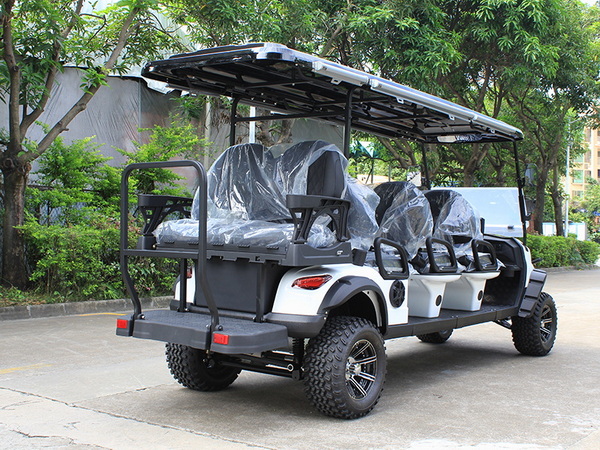
What “Golf Cart Wheel Size” Really Means
Most golf cart wheels on today's market range from 8 inches up to 15 inches in diameter, with 8, 10, 12, and 14 inches being the most common sizes. In almost all cases, the typical wheel width is about 7 inches, regardless of diameter.
Key points to understand:
- Wheel diameter (height of the rim): 8", 10", 12", 14", 15" are standard options.
- Wheel width: Most golf cart wheels are approximately 7 inches wide.
- Standard OEM size: Many stock golf carts leave the factory with 8" wheels and around 18" tall tires.
For non-lifted carts, suspensions typically accept up to about 18" total tire height with wheels under 12" diameter; beyond that, a lift kit or suspension changes are usually required.
How to Read Golf Cart Wheel and Tire Sizes
To choose or upgrade your setup correctly, it is essential to understand how wheel and tire sizes are written and how they work together.
Wheel size notation
Wheel specs are often listed as:
- Height x Width, Offset – for example, 12x7, 3:4 (offset).
Where:
- The first number is wheel diameter (inches).
- The second number is wheel width (inches).
- The offset describes how the mounting surface is positioned relative to the wheel centerline.
Tire size notation
There are two common formats.
1. Inch-based all-terrain format (example: 18x8.50-8)
- 18 = overall tire height in inches.
- 8.50 = tire width in inches.
- 8 = wheel diameter in inches that this tire fits.
2. Metric low-profile format (example: 205/50-10)
- 205 = width in millimeters.
- 50 = aspect ratio (sidewall height as a percentage of width).
- 10 = wheel diameter in inches.
In practice, a 205/50-10 tire fits a 10" wheel and is roughly 18" tall, while a 215/50-12 tire fits a 12" wheel and is about 20.5" tall.
Step-by-Step: How to Measure Golf Cart Wheels
Accurate measurements ensure that new wheels fit without rubbing on the body, fenders, or suspension.
1. Measure wheel diameter
- Remove the wheel and lay it flat.
- Measure from one bead seat (where the tire sits) across to the opposite bead seat.
- A quick rule: measure total outer height and subtract about 1 inch to account for the bead seats on both sides.
If you measure 13" total outer height, subtract 1" to get a 12" wheel.
2. Measure wheel width
- Place the wheel face-down on the ground.
- Measure from bead seat to bead seat across the width.
- You can also measure full exterior width and subtract about 1 inch as an approximation.
In most cases, you will end up with a nominal width of 7 inches.
3. Measure wheel offset and backspacing
Offset describes where the mounting pad sits relative to the wheel centerline and has a major impact on clearance and handling.
- Zero (center) offset: Mounting surface is in the center of the wheel.
- Negative offset: Mounting surface is closer to the cart; the wheel sits farther out to widen the stance.
- Positive offset: Mounting surface is closer to the street side; the wheel moves inward under the cart.
Too much negative offset can cause the wheel to stick out and rub the fenders, while too much positive offset can make the tire rub the chassis or suspension. A safe practice is to match OEM offset and backspacing as closely as possible and keep wheel diameter at 12" or below on non-lifted carts.
Standard Golf Cart Wheel Sizes and Use Cases
Both OEM and aftermarket golf cart wheels usually follow certain standard dimensions. A consistent width of about 7 inches is common, with the diameter chosen to fit within the cart's chassis and fenders at normal ride heights.
Typical golf cart wheel options
Wheel diameter | Typical width | Typical use case | Notes |
8" | 7" | OEM stock carts on golf courses | Often paired with 18x8.50-8 tires for standard ride height. |
10" | 7" | Mild upgrades and comfort-focused tires | Common with 205/50-10 or 205/65-10 for a smoother ride. |
12" | 7" | Popular aftermarket, low-profile or all-terrain | Frequently used on non-lifted carts within tire height limits. |
14" | 7" | Aggressive, lifted, off-road style | Often used with lift kits and taller tires. |
15" | 7" | Custom and premium builds | Less common but increasingly used for distinctive styling. |
Many OEM carts use 18x8.50-8 tires, meaning 18" tall, 8.5" wide, on an 8" wheel. Aftermarket setups can go up to 14" wheels and beyond, provided overall tire height and offset are correctly matched to the cart.
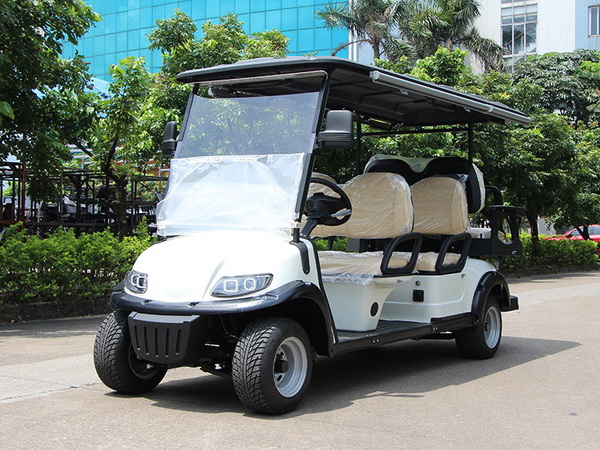
Non-Lifted vs. Lifted Carts: What Fits
Wheel and tire choices depend heavily on whether your cart is stock height or lifted.
Non-lifted carts
For stock suspension carts, typical safe tire height limits are:
- Many non-lifted carts: about 18"–20.5" overall tire height, depending on brand and model.
- A widely used rule: keep wheels at 12" diameter or less and stay within manufacturer-recommended tire heights.
Common non-lifted combinations include:
- 8" wheel with 18x8.50-8 tire (approx. 18" tall).
- 10" wheel with 205/50-10 or 205/65-10 (approx. 18"–20.5" tall).
- 12" wheel with 215/40-12 or 215/50-12 (approx. 18.5"–20.5" tall).
Lifted carts
Lift kits allow the use of larger diameter tires, often 20"–25" tall or more depending on lift height and wheelbase.
Typical lifted combinations include:
- 12" wheel with 22x10-12 or 23x10-12 off-road tires.
- 14" wheel with 23x10-14 or 25x10-14 tires on more aggressive builds.
Lifted carts almost always use negative offset wheels to push the tires outward and prevent rubbing on the frame when turning.
Bolt Pattern: The Critical Fitment Check
Even if diameter and width are correct, a wheel will not bolt on if the bolt pattern does not match the hub.
- The most common golf cart bolt pattern is 4x4" (4 lugs on a 4" circle).
- The pattern is measured from the center of one wheel stud to the center of the diagonally opposite stud.
Most modern electric and gas golf carts from major brands use this pattern, but it is always safer to confirm your specific cart's bolt pattern before ordering aftermarket wheels.
Wheel Size, Performance, Comfort, and Style
Choosing the best wheel size means balancing performance, comfort, and appearance.
Ride comfort and handling
- Smaller wheels with taller tires (more sidewall) offer a softer, more forgiving ride on rough surfaces.
- Larger wheels with low-profile tires provide sharper steering response and a sportier feel but can transmit more vibration.
- Comfort-focused sizes such as 205/65-10, 215/50-12, and similar profiles add sidewall height to absorb bumps and improve passenger comfort.
Load and speed ratings
Tires must be matched to both vehicle weight and top speed.
- Load ratings indicate the maximum weight each tire can safely carry.
- Speed ratings specify the maximum safe operating speed for the tire.
Street-legal or higher-speed carts often require upgraded tires with higher load and speed ratings to remain safe and compliant.
Visual impact and stance
Larger wheel diameters and more negative offset create a wider, more aggressive stance and highlight custom finishes such as machined faces or two-tone designs. However, pushing size and offset too far without the correct suspension and fender clearance can lead to rubbing and premature wear.
Practical Upgrade Scenarios and Suggested Dimensions
The following scenarios illustrate how to use wheel dimensions to meet common upgrade goals.
Subtle style upgrade for a non-lifted cart
Goal: A more modern look without affecting ride height or requiring a lift.
- Wheel: 10x7 with near-stock offset.
- Tire: 205/50-10 or similar (around 18" tall).
- Result: Clean visual upgrade, minimal rubbing risk, and stock suspension compatibility.
Comfort-focused neighborhood or street cart
Goal: Softer ride on pavement and light gravel, ideal for community and street use.
- Wheel: 10x7 or 12x7 with moderate negative offset for stability.
- Tire: Comfort profiles such as 205/65-10 or 215/50-12 (around 20.5" tall where clearance permits).
- Result: Taller sidewall for improved shock absorption and smoother ride for all passengers.
Off-road or trail-focused lifted cart
Goal: Maximum ground clearance and traction on uneven terrain.
- Wheel: 12x7 or 14x7 with negative offset to push tires outward.
- Tire: 22x10-12, 23x10-12, or 23x10-14+ depending on lift height.
- Result: Greater obstacle clearance, aggressive tread for loose surfaces, and a wider stance for stability.
Simple Pre-Purchase Checklist
Use this quick checklist to avoid common wheel fitment mistakes.
1. Confirm cart type and suspension
- Identify whether the cart is non-lifted or lifted.
- Check the manufacturer's maximum recommended tire height.
2. Verify bolt pattern
- Confirm whether your cart uses a 4x4" or another bolt pattern.
3. Choose an appropriate overall tire height
- Non-lifted: Usually around 18"–20.5" depending on model.
- Lifted: Often 20"–25"+ depending on lift height and body clearance.
4. Match wheel offset and backspacing
- Stay close to OEM values for non-lifted carts.
- Use negative offset for lifted and off-road builds to help avoid rubbing.
5. Check load and speed ratings
- Ensure tires are rated for added seats, cargo, and any higher road speeds.
Why Correct Wheel Sizing Protects Your Cart
Beyond aesthetics, correctly chosen wheel dimensions protect both the cart and its occupants.
- Safety: Incorrect diameter or offset can cause rubbing, steering issues, or reduced braking effectiveness, especially at higher speeds.
- Component wear: Oversized or poorly offset wheels increase stress on bearings, suspension, and steering components, shortening service life.
- Efficiency: On electric carts, very tall tires effectively raise the gear ratio, which can reduce acceleration and range if not matched to the motor and controller.
Choosing wheel dimensions within recommended ranges keeps the cart predictable, efficient, and economical to maintain.
Considering ATV or Car Wheels on a Golf Cart
At first glance, replacing golf cart wheels with ATV or car wheels may look simple, but there are critical details to check.
- While some 4x4 bolt patterns appear similar, ATV and UTV wheels often use slightly different bolt circle diameters.
- Even small differences in bolt distance can create stress on studs and hubs and lead to damage or failure.
Using wheels specifically engineered for golf carts is usually the safest choice and simplifies future maintenance and parts sourcing.
Maximizing Tire Size: How Big Can You Go?
Standard golf cart suspensions are generally engineered to accommodate tires up to roughly 18" overall height without modifications. In practice, this means the ideal wheel diameter stays at or below 12" for most non-lifted carts.
If you want to run 14" wheels with more aggressive, taller tires, a properly matched lift kit is often required to provide sufficient clearance. Without this extra space, large tires can contact the chassis or bodywork, damaging both components.
Many modern carts and factory-lifted models are now offered with 14" wheels and off-road tires pre-installed, giving owners a ready-made solution for more adventurous use without the need for aftermarket lifting.
Selecting the Right Wheel for Your Application
Whether your priority is a subtle aesthetic upgrade, higher comfort, or a bold off-road stance, the key is understanding three basics: wheel diameter, width, and offset.
- Start from your current OEM specs and decide how much you want to change the look and ride.
- Confirm bolt pattern, tire height limits, and load/speed requirements before ordering.
- Choose a wheel and tire combination that supports your typical terrain and passenger load.
A well-planned wheel upgrade not only transforms appearance but also supports better handling and long-term reliability.
Take the Next Step with Professional OEM Support
If you are ready to upgrade from basic OEM wheels to a configuration that truly matches your market, relying on a professional manufacturing partner can make the process faster, safer, and more profitable. As a dedicated manufacturer of golf carts and small electric vehicles, LANGQING provides OEM and private-label wheel and tire solutions tailored to international brands, wholesalers, and vehicle producers.
Share your target vehicle specifications, terrain conditions, and customer expectations, and LANGQING can help you define standardized wheel diameters, offsets, and tire packages that fit correctly and perform reliably across your entire product line. Contact the LANGQING team today to discuss your next wheel program and turn precise golf cart wheel dimensions into a clear competitive advantage.
Contact us to get more information!
Frequently Asked Questions (FAQ)
1. What is the most common golf cart wheel size?
The most common OEM wheel size is 8x7, typically paired with an 18" tall tire such as 18x8.50-8. This combination offers a good balance of comfort, stability, and compatibility with stock suspensions.
2. How big can I go on a non-lifted golf cart?
Many non-lifted carts can safely run tires in the 18"–20.5" range, usually on 10" or 12" wheels, depending on the cart model and suspension condition. Always check clearance around the fenders and chassis before finalizing an upgrade.
3. Do larger wheels make my golf cart faster?
Larger overall tire diameters can slightly increase top speed by changing the effective final drive ratio, but they may also reduce acceleration and put extra load on the motor and brakes. Any speed gains should always be balanced against safety and component limits.
4. Why does wheel offset matter so much?
Wheel offset determines how far the wheel sits inward or outward relative to the hub, directly affecting fender and chassis clearance, steering geometry, and bearing loads. The wrong offset can cause rubbing, poor handling, and premature wear of suspension parts.
5. Can I mix different wheel sizes on the same golf cart?
All four wheels should use tires with the same overall height and compatible load and speed ratings to maintain stable handling and even braking. Mixing sizes on a golf cart is not recommended and can create unpredictable driving behavior.
Citations:
1. https://evolutionelectricvehicle.com/understanding-golf-cart-wheel-dimensions-a-step-by-step-guide/
2. https://www.golfcarttiresupply.com/golf-cart-wheel-size-explained/
3. https://www.golfcartstuff.com/blogs/news/golf-cart-wheel-sizing-explained
4. https://www.buggiesunlimited.com/how-to-measure-golf-cart-wheels.asp
5. https://www.golfcarttiresupply.com/how-to-read-golf-cart-tire-sizes/
6. https://golfcartgeeks.com/blogs/news/how-to-measure-golf-cart-wheels
7. https://www.golfcarttiresupply.com/golf-cart-tire-speed-and-load-rating-lists
8. https://golfcartstuff.com/blogs/news/golf-cart-wheels-common-questions-answered
9. https://hartvillegolfcarts.com/what-size-are-golf-cart-tires/
10. https://diamondgolfcars.com/choosing-the-right-golf-cart-tires-a-comprehensive-guide/
11. https://www.chapmoto.com/blog/motorcycle-gear-guides/the-essential-guide-to-golf-cart-tire-sizes/
12. https://extremekartz.com/pages/all-about-wheels-and-tires


