Content Menu
● What “Golf Cart Size” Really Means
● Step 1: Define How You Will Use the Cart
● Step 2: Match Seating Capacity to Real Usage
● Common Golf Cart Dimensions by Seat Count
● Step 3: Check Storage Space, Doorways, and Trailers
● Step 4: Think About Terrain and Turning Radius
● Step 5: Consider Passenger Comfort and Ergonomics
● Step 6: Factor in Payload, Accessories, and Future Upgrades
● Golf Cart Tire and Wheel Dimensions
● Electric vs. Gas: Does Powertrain Change Size?
● Practical Size‑Selection Checklist
● When a Compact Golf Cart Is the Best Choice
● When a Larger Multi‑Row Cart Makes Sense
● Expert Tip: Always Verify Manufacturer Specifications
● Where a Professional OEM Partner Adds Value
● Top Quality Golf Carts and Sizing Support
● Ready to Choose the Ideal Golf Cart Size?
● FAQs About Golf Cart Size
>> FAQ 1: What is the standard size of a 2‑seat golf cart?
>> FAQ 2: How much longer is a 4‑seat golf cart than a 2‑seat?
>> FAQ 3: Will a golf cart fit in a standard single‑car garage?
>> FAQ 4: Do larger tires change the overall size of my golf cart?
>> FAQ 5: Is a 6‑seat golf cart harder to drive than a smaller model?
● Citations:
Choosing the right size golf cart is about much more than how many seats it has – it affects comfort, safety, storage, and total ownership cost. A well‑sized cart fits your daily use, your space, and your passengers, without creating handling or storage headaches.
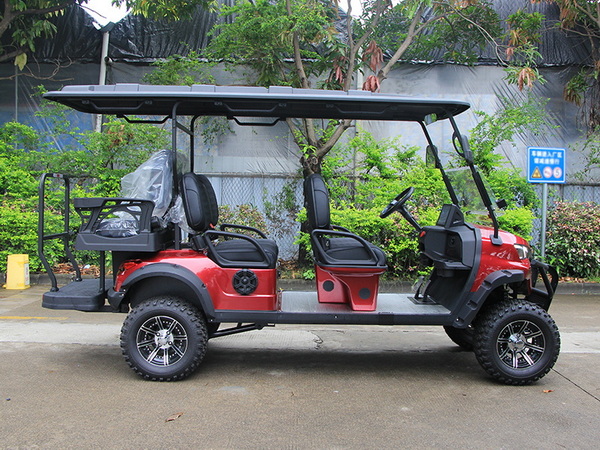
What “Golf Cart Size” Really Means
When people talk about golf cart size, they usually mean a combination of overall dimensions and usable capacity, not just how big it looks from the outside. In practice, size is a mix of length, width, height, seating capacity, and payload.
Key elements of golf cart size include:
- Overall length, width, and height
- Number of seats and seating layout
- Wheelbase and turning radius
- Payload capacity (passengers plus cargo)
On average, a standard 2‑seat golf cart is around 8 feet long, 4 feet wide, and about 6–6.5 feet tall. Larger multi‑row models can be significantly longer, which has a direct impact on maneuverability and storage.
Step 1: Define How You Will Use the Cart
Before you compare dimensions and specifications, clarify exactly where and how the cart will be used. This first step helps you avoid choosing a cart that is technically impressive but impractical in daily life.
Ask yourself:
- Will you drive mainly on golf courses, in gated communities, or on private property?
- How many people will you carry most of the time, not just occasionally?
- Do you need extra cargo space for tools, luggage, or equipment?
- Will you tow small trailers or move heavier loads?
For example, a homeowner using a cart in a community and occasionally on the golf course is often best served by a 4‑seat cart with a rear‑flip seat that converts to cargo space when needed.
Step 2: Match Seating Capacity to Real Usage
Seating capacity is usually the first size decision buyers make, and it should be based on regular usage rather than rare scenarios. Oversizing just for the rare extra passenger can lead to unnecessary cost and handling challenges.
Typical seating configurations include:
- 2‑seater: Ideal for solo players or pairs, plus golf bags
- 4‑seater: Practical for families or two players plus children
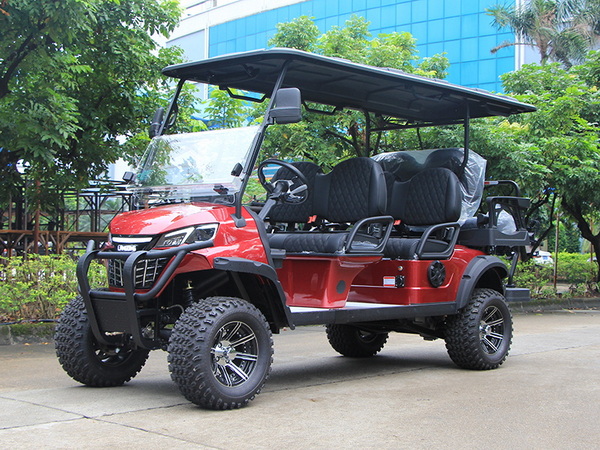
- 6‑seater: Suited for resorts, campuses, hotels, and shuttle use
Each step up in seating usually increases cart length significantly while width stays similar. This means a 6‑seat cart may still fit through the same gate as a 2‑seat cart, but it will need far more turning and parking space.
Common Golf Cart Dimensions by Seat Count
The table below shows typical dimension ranges by seating capacity. Actual values vary by brand and model, but these ranges give a realistic starting point for planning your space.
Cart Type | Typical Length | Typical Width | Typical Height | Best For |
2-seater | 92–96 in (7.5–8 ft) | ≈ 48 in (4 ft) | 72–75 in (6–6.25 ft) | Individual players, couples, small garages |
4-seater (rear-facing) | 108–118 in (9–10 ft) | 48–54 in (4–4.5 ft) | 72–84 in (6–7 ft) | Families, communities, resort use |
6-seater “limo” | 140–160 in (11.5–13 ft) | 54–58 in (4.5–4.8 ft) | 72–80 in (6–6.5 ft) | Hotels, campuses, shuttles, tours |
These dimensions help you check in advance how much space the cart will occupy in your garage, warehouse, trailer, or parking area.
Step 3: Check Storage Space, Doorways, and Trailers
Even if a cart feels perfect on the course, it must fit where you store and transport it. Ignoring basic measurements is one of the most common and costly mistakes.
Consider the following points:
- Garage depth and width, including shelves or cabinets
- Garage door height and width
- Any pillars, steps, or equipment the cart must clear
- Trailer deck size and loading ramp width
A standard 2‑seat cart usually pairs well with a 5×10 ft trailer, while 4‑seat and 6‑seat carts often require 6×12 ft or larger. Always measure from bumper to bumper and side to side before buying, including any rear seat kits or cargo boxes.
Step 4: Think About Terrain and Turning Radius
Cart size strongly impacts maneuverability, especially on tight golf paths, resort driveways, or narrow residential lanes. Longer carts are more stable at speed but less agile in tight spaces.
In general, larger carts have:
- A larger turning radius
- A longer braking distance when fully loaded
- More difficulty in narrow paths and tight corners
If you regularly drive on narrow or hilly courses with sharp turns, a more compact 2‑ or 4‑seat model offers better control and safety. For wide‑open areas, a longer 4‑seat or 6‑seat cart is usually comfortable to operate.
Step 5: Consider Passenger Comfort and Ergonomics
Good sizing is not only about exterior dimensions; interior space and ergonomics are critical for comfort, especially on longer rides. A cart that feels cramped quickly becomes frustrating for passengers.
Key comfort points include:
- Seat width, cushioning, and back support
- Legroom for each row, especially rear seats
- Grab handles and armrests for passengers in the back
- Step‑in height for elderly or mobility‑limited riders
Longer wheelbases often provide a smoother ride, which is valuable if you regularly carry a full load of passengers on uneven ground or over longer distances.
Step 6: Factor in Payload, Accessories, and Future Upgrades
Many buyers underestimate how accessories and payload affect real‑world size needs. A cart that seems adequate on paper can become overloaded once everything is installed.
Important factors to review:
- Payload rating (total weight of passengers, cargo, and accessories)
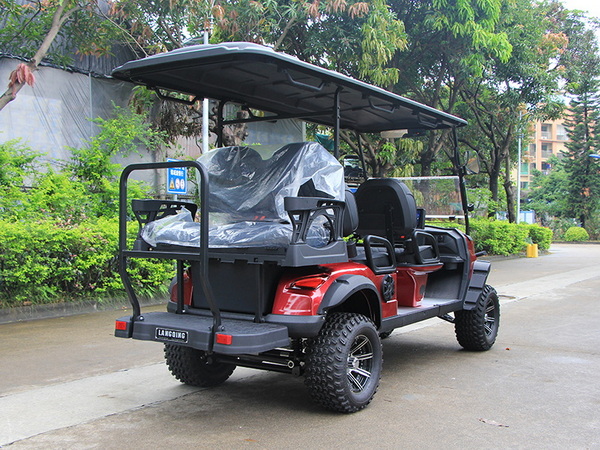
- Planned accessories: rear seat kits, cargo beds, enclosures, roof racks, lift kits
- Future upgrades such as utility boxes, coolers, or towing hitches
Adding lift kits and larger tires increases overall height and can slightly change effective length. This may affect garage clearance, trailer fit, and stability if not matched with the right suspension and frame design.
Golf Cart Tire and Wheel Dimensions
Tire and wheel dimensions influence both overall cart size and performance on different surfaces. Choosing the right combination helps you balance stability, comfort, and practicality.
Key points about tire and wheel size:
- Standard carts often use 8–10 inch wheels with matched tires to keep overall width around 4 feet
- Larger tires improve ground clearance and ride comfort, especially on rough terrain
- Very large wheels and tires can make it harder for carts to clear low garage doors or enclosed trailers
If you operate in hilly, sandy, or soft terrain, slightly larger tires can offer better traction and stability. Always check how any tire and wheel upgrade will affect overall height and turning clearance.
Electric vs. Gas: Does Powertrain Change Size?
Most modern carts for communities and many courses are electric, and their external dimensions are often similar to gas models in the same seat class. However, the powertrain affects weight distribution and operating environment.
Electric carts typically:
- Offer quiet operation, ideal for residential and resort environments
- Have different weight balance due to battery placement
- Require clear space for safe, ventilated charging near storage
If your priority is low noise and low emissions, a properly sized electric cart provides a cleaner, quieter solution. The size decision then focuses mainly on seats, storage, and terrain rather than on the power source itself.
Practical Size‑Selection Checklist
Use this step‑by‑step process before choosing a golf cart size. It reduces guesswork and helps you match the cart to your environment and usage.
1. List your main uses: golf only, neighborhood, resort, shuttle, or mixed use.
2. Count regular passengers: the number you carry most often, not the maximum you might need once a year.
3. Measure storage: garage length, width, and door height, including any shelves or steps.
4. Check transport options: trailer size, truck bed dimensions, or confirm that no transport is needed.
5. Evaluate terrain: flat, hilly, off‑road, narrow paths, or paved roads.
6. Decide on key accessories: rear seat, cargo box, enclosure, lift kit, or special tires.
7. Choose seat capacity, then confirm dimensions in the manufacturer's specification sheet.
Completing this checklist before shopping helps you avoid overspending on a cart that is too big or regretting a cart that is too small for daily use.
When a Compact Golf Cart Is the Best Choice
A compact golf cart is usually the best option when space and maneuverability are more important than maximum passenger capacity. It is also ideal if most trips are short and loads are light.
Choose a smaller cart if:
- Your garage or storage depth is limited
- You drive on narrow paths, tight community roads, or crowded facilities
- Only one or two people ride most of the time
- You prioritize easy handling, parking, and transport
Compact 2‑seat or short‑wheelbase 4‑seat carts still carry golf bags and light cargo, while reducing turning radius and parking stress.
When a Larger Multi‑Row Cart Makes Sense
Larger 4‑seat and 6‑seat carts are designed for moving people efficiently. They can transform guest experiences in commercial environments and improve productivity where people and equipment need to move frequently.
Consider a larger cart if:
- You run a hotel, resort, campus, industrial site, or tourist attraction
- Your family or team frequently rides together, often with guests
- You regularly move groups for events, tours, or shuttles
- You have wide, open spaces, generous driveways, and broad paths
In these scenarios, the extra length is justified by higher capacity and fewer trips, as long as you verify your storage space and turning requirements.
Expert Tip: Always Verify Manufacturer Specifications
Average dimensions are helpful, but real carts from different brands can vary several inches in length and height. A small difference on paper can be critical in tight garages or trailers.
Before purchasing any model:
- Download or request the detailed specification sheet
- Confirm exact values for length, width, height, wheelbase, and ground clearance
- Check notes related to optional seat kits, roofs, windshields, or cargo beds
Many manufacturers also publish maximum loaded weight and recommended passenger capacity. Respecting these limits is important for safety, performance, and warranty coverage.
Where a Professional OEM Partner Adds Value
For dealers, importers, and brand owners, the right manufacturing partner can help you fine‑tune cart size to your market rather than forcing your business to fit generic dimensions. This is especially important when you serve multiple regions with different standards.
An experienced OEM factory can:
- Customize seat layouts, including 2/4/6 seats, rear‑facing seats, and utility beds
- Adjust body dimensions to fit specific garages, trailers, or community regulations
- Match battery configuration, motor power, and suspension to cart size and payload
- Deliver consistent quality and unified styling across fleets for resorts, courses, and campuses
By working directly with an OEM partner, you can offer golf carts that match your customers' real‑world spaces and usage patterns instead of compromising on size, comfort, or usability.
Top Quality Golf Carts and Sizing Support
Choosing the right size golf cart becomes much easier when you have direct guidance from specialists who understand both technical specifications and real‑world operation. A strong product lineup combined with professional support helps end users avoid expensive sizing mistakes.
A high‑quality sales or OEM team can:
- Help you interpret dimension sheets and turning radius data
- Recommend appropriate seat configurations for typical passenger loads
- Advise on tire and wheel choices that balance size, comfort, and clearance
- Suggest charging setups and storage layouts for electric fleets
With the right support, you can create a product range that feels tailored to your market, from compact personal carts to extended multi‑row shuttles.
Ready to Choose the Ideal Golf Cart Size?
If you have clarified your usage, measured your storage and transport space, and considered passenger comfort and terrain, you are ready to choose the ideal golf cart size with confidence. The final step is to match these requirements with a reliable manufacturing and supply partner.
If you are a brand owner, importer, or distributor looking for OEM or private‑label golf carts and small electric vehicles, we invite you to collaborate with LANGQING. As a professional Chinese factory specializing in golf carts and compact electric vehicles, we customize dimensions, seating layouts, and performance to match your market's exact needs. Contact LANGQING today to discuss your project, request specification support, and start developing a perfectly sized golf cart lineup for your customers.
Contact us today to get more information!
FAQs About Golf Cart Size
FAQ 1: What is the standard size of a 2‑seat golf cart?
A typical 2‑seat golf cart is about 92–96 inches long, around 48 inches wide, and roughly 72–75 inches tall, depending on the brand and model. These dimensions are compact enough for most single‑car garages and small trailers.
FAQ 2: How much longer is a 4‑seat golf cart than a 2‑seat?
Most 4‑seat golf carts are roughly 1–3 feet longer than 2‑seat models, with lengths commonly ranging from 108 to 118 inches for standard non‑lifted designs. The width is often similar, so the main difference is the extra length needed for storage and turning.
FAQ 3: Will a golf cart fit in a standard single‑car garage?
In many cases, a 2‑seat golf cart fits comfortably in a standard single‑car garage, especially if you park it nose‑to‑wall. However, it is essential to measure both your garage depth and the cart's total length, including any rear seat or cargo accessories.
FAQ 4: Do larger tires change the overall size of my golf cart?
Yes, larger tires increase the overall height of the cart and can change how it fits under garage doors, in enclosed trailers, or under low roofs. Depending on the size change, you may also need suspension or body adjustments to maintain safe clearance and stable handling.
FAQ 5: Is a 6‑seat golf cart harder to drive than a smaller model?
A 6‑seat golf cart usually has a larger turning radius and a longer stopping distance, especially when fully loaded. It is still easy to drive in open spaces, but it requires more attention and space in narrow paths, parking lots, and areas with tight corners.
Citations:
1. https://golfcarts.com/how-to-choose-the-right-size-golf-cart-for-your-needs/
2. https://wis-tek.com/blogs/knowledge/comprehensive-guide-to-golf-cart-dimensions-width-length-and-height-explained
3. https://jsgolfcarts.com/blog/golf-cart-dimensions/
4. https://www.gowithgarretts.com/golf-cart-dimensions-size-does-matter/
5. https://www.golfsidekick.com/knowledge/golf-cart-dimensions/
6. https://www.taragolfcart.com/news/golf-cart-dimensions-a-complete-guide-for-australian-golfers-and-clubs/
7. https://ecoplaneta.com/golf-cart-dimensions/
8. https://golfcarsofthedesert.com/blogs/news/how-to-choose-the-right-size-golf-cart-for-your-needs
9. https://support.classicaccessories.com/hc/en-us/articles/4554696735124-How-to-measure-Golf-Carts
10. https://www.vipgolfcartservice.com/blog/golf-cart-buyers-guide-how-to-choose-the-right-golf-cart
11. https://www.golfcartgarage.com/blog/golf-cart-dimensions-and-their-importance/
12. https://global.yamaha-motor.com/business/golfcar/products/4-6-seater/
13. https://golfcarts.com


